
What’s the most important thing in life? Ask that from 100 people and most of the answers will reflect happiness in one way or the other. Unfortunately it may also be one of the hardest things to achieve in life. Changing your diet is a voluntary decision, but you have far less control over your emotional responses.
I just finished writing a lengthy chapter on stress to my book. While researching that chapter I became even more aware of the many ways stress, anxiety and negative emotions affect physical health. The skin is innervated with stress-sensing nerves. In response to stress and anxiety these nerves signal the skin to produce more sebum, induce inflammation, and accelerate skin cell growth. To put it in other words, stress has ‘built in’ all the ingredients for baking a pimple.
A few days back I stumbled onto some interesting psychological research on embodied cognition. These studies show how to manipulate feedback mechanisms between the mind and the body to influence emotional states and response to stress. I also fortuitously stumbled on a few studies on the effect of language and language patters on emotional states and responses.
So let’s take a look at this weird concept of embodied cognition and how you might use it to feel better and deal with stress.
Theory of embodied cognition
The theory of embodied cognition states that the mind and the body are not separate (but not ‘not separate’ in a new age fashion). Traditional theories of psychology state that the brain is like a meat computer and is responsible for all cognitive processes (such as thoughts, emotions, decisions, judgments). Perception is the input to the computer that then computes the input into thoughts, feelings and actions.
Embodies cognition theory says that the body plays a much larger part in these cognitive processes. And that the mind-body relationship is not a one way stress, what the body does actually feeds into and affects these cognitive processes. It’s similar to the ‘As If’ principle I talked about in the previous post about acne anxiety.
Scientific American blog section has a good article on embodied cognition. Let me pull a few examples from there to illustrate this weird concept:
- People holding a warm cup of coffee as opposed to iced coffee judged a stranger as more trustworthy, warm are friendly and familiar.
- People holding heavier clipboards judged currencies to be more valuable than those who held lighter clipboards, heavy is important.
- Leaning left makes you underestimate the magnitude of things, smaller numbers are located in the left hand side of scales and rules.
Here’s another nice article on embodied cognition with some more examples. These examples show that the actions and feedback from the body affects cognitive processes. Some psychologists say that embodied cognition is much more than this, but this is enough for our purposes.
Let’s look at some studies that show how to use this principle to get rid of negative emotions and deal with stress.
How to throw away negative thoughts
We are all bothered by negative thoughts, ghosts of the past that return to haunt our present. Unfortunately the Ghostbusters’ Who You Gonna Call hotline has gone dead. But a hot off the press shows getting rid of these thoughts can be as simple as throwing them away.
Kudos to The Skeptics Guide To The Universe podcast for bringing this up in a recent episode. This study showed that writing down thoughts, both negative and positive, sort of objectifies the thought into the paper. What you later do with the paper affects the power that thought has over you.
A study just published in the journal Psychological Science illustrates this nicely. In the study the Spanish and American researchers did three experiments. In the first experiment they asked people to write one thing, either positive or negative, about their body. Then half of the participants were asked to contemplate on what they wrote down and then throw the paper into trash. The other half was asked to contemplate and then check what they wrote for grammar and spelling errors. The results showed that keeping the paper matters. Those who wrote positive thoughts rated their bodies more favorably than before the test, and vice versa for those who wrote negative thoughts. But no change in body image was observed in people who trashed the paper.
In the second experiment people were asked to write positive or negative things about the Mediterranean diet, something most people consider as good and healthy. Then they were asked to trash the paper, keep it on their desk, or keep it in their person (such as in wallet or purse). As in the first experiment, those who kept the paper on their desk had a move favorable attitude towards Mediterranean diet. However those who kept the paper in their person were even more influenced by it.
In the third experiment the researchers did the same thing using computers. The participants were either asked to move the document either to the recycle bin or save it into their hard drive. Again, people who virtually trashed the document showed less effect than those who kept the document by saving it.
Finally, here’s a killer for all self-help hype. Imagining, or visualizing, the same thing had no effect. In other words, you have to objectify the thought with a piece of paper or text document.
If you want to know more, MedicalXpress.com has a brief interview with one of the study co-authors.
Grin and bear it: Fake smiles help to cope with stress
In another study recently published in Psychological Science researchers looked at the effect of forced smiling on stress recovery. They subjected 170 18 – 25 years old university students to psychological (tracing a star via mirror, like in this video) and physical stress (one hand submersed in very cold water). During the stress they were asked to hold chopsticks in their mouth in a way that either produced a neutral expression, a standard smile that only engaged the muscles around the mouth, or Duchenne smile that also engaged the muscles around the eyes, as shown in this picture.
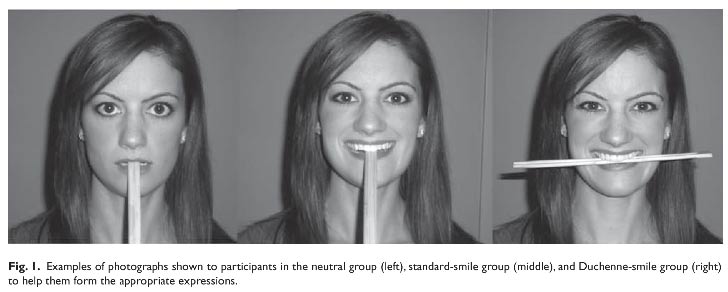
Source: Tara L. Kraft, Sarah D. Pressman. Grin and Bear It: The Influence of Manipulated Facial Expression on the Stress Response. Psychological Science November 2012 vol. 23 no. 11 1372-1378.
After the stress the participants were allowed to recover, during which the researchers measured their heart rate. The participants were only asked to ‘fake smile’ during the actual stresses and not during the recovery period.
They found that fake smiling both reduced the physical effect of stress on the body and improved recovery from stress. Immediately following psychological stress the average heart rate in the Duchenne smile was 74 BPM and 79 and 81 BPM in the standard smile and neutral groups respectively. 90 minutes later both of the smiling groups had dropped to around 65 BPM and stayed there until the last measure (6 hour mark). Whereas the standard group dropped to 72 BPM at 90 minutes and declined slightly to 70 BPM at the 6 hour mark. So the people in the neutral group had quite a bit higher heart rate even 6 hours after a relatively minor stress. Results after the cold water exposure test were similar, except that the Duchenne smile group had a larger edge of the ‘standard’ smile and neutral groups at every point of time.
So how could you use this? Well, plastering a fake smile (remember to involve the muscles around the eyes also) may help during the times you have to endure an annoying or otherwise stressful situation. It helps you to feel better later and your body doesn’t suffer as badly.
I wouldn’t use this technique all the time though. One study showed that forcing waiters to smile all the time lead to faster burnout. So constantly forcing emotional incongruence may actually be bad.
Feelings into words
Let’s move on to research that’s not so much amount embodied cognition but something similar. Or as they say here in Thailand ‘same same but different’.
A study by University of California researchers looked at the effect of verbalizing your feelings. They took 88 people afraid of spiders and exposed them to a live spider in various ways. They then divided the participants into four groups and, as they were exposed to the spiders, asked them to say something along these lines:
- Feelings into words: I’m afraid this disgusting tarantula will jump on me.
- Rationalize, asked describe the event in neutral terms: Looking at this little spider is not dangerous to me.
- Distraction, describe some furniture in their house: There is a television in front of the couch in my den.
- Exposure alone, weren’t asked to say anything.
The researchers then exposed all the participants to the spiders again immediately and one week later. During the exposure their skin conductance was measured, which is an objective measure of emotional response. During one exposure the researchers asked the participants to take steps closer to the spider and in the last step to actually touch the spider.
Surprisingly the results showed that putting your feelings into words was the most effective in reducing skin conductance and getting people to get closer to the spider. Rationalizing the fear (saying this spider isn’t dangerous to me) actually intensified the fear, as shown by increase in skin conductance, as did distracting yourself. Talking about your fear also got people to take more steps towards the spider.
The researchers speculate that the reason putting your feelings into words helps could be that it makes you more mindful of the situation. You become more aware of what’s going on in your head and that helps you to deal with it better.
I wonder what would have happened if these people would have written down their thoughts and then trashed the paper.
Mind your verbs
Another paper showed how the verbs you use to describe past emotional experiences affects your current mood. Unfortunately I don’t have access to the full-text study, so I can’t give you a lot of details. But from the abstract it looks like the researchers asked the study participants to describe past emotional experiences, either positive or negative, and then measured how this influenced present mood.
They found that the language structure used to describe past emotional experiences affected present mood. Those who used imperfective aspect, which implies ongoing or habitual experience, were affected more than people who used perfective aspect, which implies completion.
Disclaimer, I suck as grammar and English is my second language, so take these examples with a grain of salt, but here’s how I understood it.
- Imperfective aspect: My husband has always abused me/ my parents have been fighting a lot.
- Perfective aspect: My husband abused me/ my parents fought a lot, or used to fight a lot.
In the paper they mentioned that those who used imperfective aspect recalled the events better, and this caused the difference in present mood. Now, I can’t say which way the causality flows here. Did better memory of the situation cause the imperfect aspect use or the other way around? But this research suggests that describing your negative past emotions in a way that implies completion helps you to deal with them better.
Take home messages
The studies on embodied cognition show that we never think in vacuum. Instead what the body does affects your thoughts, feelings, and actions more than you may realize. An opportunistic person might consciously manipulate these feedback mechanisms in a way that improves mood and reduces stress.
Examples include writing negative thoughts on a piece of paper and then either trashing or burning the paper. This reduced the effect those thoughts have on you. But when you write positive thoughts you want to keep the paper in your person, such as in your wallet or purse, which helps to reinforce their importance.
Plastering a fake smile during stressful times mitigates both the physical and emotional effects of stress. Similarly putting your feelings into words, either in writing or just saying them aloud, can reduce fear and anxiety. Vocalizing your feelings helps you to be more mindful of what’s going on in your head and deal with the situation better. Finally, describing negative experiences in a way that implies completion reduces their effect on you.
Stress and anxiety can be the hardest to deal with aspects of acne. Changing your diet is a voluntary decision, whereas you have far less control over your emotional responses to anxious and stressful situations. But psychological research shows that there are feedback mechanisms between the mind and the body you can consciously manipulate to gain better control over your emotional responses.

Agreed. There is a book by the name of The secret, I forgot the author’s name. But there on she explained the effects of thinking not only on our body but also the things we attract from our surroundings through it. Our mind naturally do not process the negative words like no, never.
You gave the example that saying ‘spider is not dangerous to me ‘ actually intensified the fear, it was because NO is the strange word for mind, it doesn’t take that into account so the message which mind processed was without NO that ‘spider is dangerous to me’.
So one of the ways to reduce stress is to omit “no & negative expressions’ from our thoughts. For example if the same person would have said, ‘I am safe from spider’ that actually would have helped him in reducing the fear & also would have made him to understand & analyse the situation in a better way.
In short thinking positive attracts positive things !!
Thanks for your comment Maria. I do have to disagree with you about The Secret and other similar new age and self-help things. I used to be really hooked onto that stuff for several years, but have since learned better.
Psychological research actually quite clearly shows that affirmations and The Secret type ‘visualization’ not only doesn’t work but actually makes things worse. Visualization can work, but what you have to do is to visualize the effort and work you do while reaching your goal. Wishful thinking, or as new agers call it manifestation, doesn’t work. It’s actually shown to reduce motivation and goal achievement. Probably because it doesn’t prepare you for the work you have to do to reach your goal, and the work is always more than what we initially think.
My own anecdotal experience shows that the secret type of thinking and visualization was very good at creating warm and fuzzy feelings and making me feel motivated for a brief moment. But it never really helped me to achieve anything, and, thinking back, actually made me feel quite powerless. I was always putting my life to the hand of some higher power. And when the results didn’t happen felt like there was something wrong with me or I was doing something wrong. And I know I’m not the only one feeling this way.
I can honestly say I’m much happier and feel much more empowered after I left all that stuff behind.
hmmmmm…………:)
well it depends how one take those positive notions into account, in dreaming or in practical implications. I guess u took it as a whole but that was just a small part of the bigger level execution as u might have heard execution of anything without planning is futile. If somebody knows that he is going to pass the exam with flying colours, he will prepare himself for that level but if he has a fear of failing he can never ever prepare like the one who would be confident about the result. Success lies in “giving your best “& leaving the rest to ALLAH & then accepting whatever is the result as whatever happens, happens for good. & not to mention the prerequisite for giving the best is a positive feeling that motivates one to achieve it.
Above all ALLAH always say not to loose hope ever in any situation & that actually endorse that one should never be pessimistic as ALLAH is the supreme power, HE has created everything so seeking ALLAH’S help & giving your best by trying to achieve your goal is what that ensures suucess.
In general people think success is achieving what they desired for . However this is not the case as nobody knows what is best for him/her but only the One who has created us , who knows each & everything from our soul to our body , the ALLAH knows the best. So trying out your best & leaving the rest to ALLAH is the key to success , now whether the result was what we wanted or the opposite doesn’t matter as whatever happened , happened in our favour as I said earlier as well Only ALLAH knows what is best for us :).
HE loves us 70 times more than our mother !
Eat well. Vegetables, no sugars and no processed food. Doing this will reduce much of one’s negativity.
True. There’s some research to show that inflammation is a factor in depression and anxiety, and that taking omega-3 fats can reduce depression.
Seppo, I really enjoy reading your articles and I see them quite differently now that I have abandoned all the magical thinking and other BS. This one is really helpful. Actually, I have discovered that during a time of intense emotional pain, my face IS TRYING to smile. I just can’t handle it anymore and I’m looking for something to make me smile and laugh. And yes, it does help me. All the New Age and religious stuff sounds now ridiculous but I have found it’s best for my emotional health not to discuss it with people either online or offline.
Btw, verbalising your honest feelings is the best way to communicate with a loved one and to achieve intimacy. No real connection can be achieved without this. So if we share our feelings with someone close I think it will have even better results on reducing stress.
So happy to hear that you’ve seen the light of reason and abandoned the dark forest of alternative medicine nonsense 🙂 It’s still possible to use natural treatments without abandoning reason and logic, and that’s what I’m trying to promote on this blog.
Isn’t it interesting how differently you see things now? When you have the blinders on, so to say, it’s hard to see points that are so obvious without such blinders. A big part of critical thinking is realizing that all humans, including me, have such cognitive flaws and watching out and avoiding them whenever possible.
If you struggle with emotional issues I recommend trying a therapy called Rational Emotive Behavior Therapy (REBT). It’s a spin off of cognitive behavior therapy and so far the best self-help approach I’ve tried. One of my readers is a trained psychologist and he recommend that to me. So far it’s been really helpful for me.
To give you a small, personal example. About 8 months ago with my wife we bought a condo near the river in Bangkok. Bangkok being what Bangkok is (chaotic and noisy) I started getting really frustrated with all the noise coming from the river (really noisy boats). I got really angry thinking how can they be so stupid and inconsiderate to drive the noisy boats in the middle of the night.
Mind you I do have a legitimate concern since the boats are really noisy and they can easily wake you up in the middle of the night. But without proper regulations, or effective enforcement of such regulations, there’s nothing one can do about it. Even if you are right, raging about it only makes you miserable.
Using REBT I quickly realized how I was creating my own misery with my rigid demands and irrational beliefs about how the world ‘should be’. While the noise still annoys me, I don’t get angry or frustrated at it. It’s just a part of life in this part of the world.
All of this was fairly easy to achieve. REBT doesn’t have you wallow in your past of have you hunting your childhood for ‘traumatizing events’. You work with your current beliefs and self-talk, so it’s very easy approach for self-help work.
If this sounds something like you would like to try, I recommend the book that helped me deal with my anger and frustration: How To Stubbornly Refuse To Make Yourself Miserable About Anything-yes, Anything!, (affiliate link).
Hope this helps!
Oh, thank you! I will try this one when I have the time. It sounds like what Tolle says but without the mumbo jumbo.
And yes, everything seems so different now! I’m reading the same articles you wrote and now they make sense and I don’t find them cold or rude anymore. I’m a convert, lol 🙂
Glad to hear that you find the articles more acceptable now. I try, as far as possible, to remain neutral and objective (thought sometimes I fail, lol) in my posts and replies. That said, sometimes I get tired of pointing out the same things and just flat out say you are wrong. I know it’s not very conductive, but sometimes that’s the only thing I have time for.
REBT is not really like Tolle’s teachings, thought there is some overlap. REBT is more about changing your rigid beliefs and ‘musts’. Going back to my earlier example, I had a rigid belief along these lines: “My home must be peaceful and free from noise, and if it’s not it’s horrible and I just can’t stay here.” Of course, anyone who has lived in Bangkok knows that’s utter fiction, lol.
Using REBT I was able to change that to a more flexible and realistic belief along these lines: “While I would prefer to have peace at home, it’s not the end of the world if we get some noise here. The noise from boats is annoying, but it’s certainly not the end of the world and I can deal with it.”
That belief more accurately reflects reality and prevents me from working myself to anger and frustration.
I don’t remember much from Tolle’s book, but I think it was more about being aware of the present moment. And that is really helpful in spotting out negative beliefs and self-talk that you can then deal with REBT or other science-based approaches.
This is great. I am going to read into it more carefully. I know that my bad skin has a lot to do with stress and childhood trauma. Besides helping my skin with a healthy diet and lifestyle, I really need to work on the emotional aspect most of all.
Please also see the emotional acne section of this post for more.